
By the time mobile phones became widespread in Nigeria, something more fundamental had already started to take place.
President Olusegun Obasanjo’s administration (1999–2007) is widely credited with the liberalisation of Nigeria’s communications sector, most notably overseeing the revolution of the telecommunications industry. Upon taking office in 1999, Obasanjo transitioned the sector from a state-controlled, inefficient monopoly into a competitive market, leading to the rapid adoption of Global System for Mobile Communication (GSM).
From then on, communication was no longer the constraint it once was. The explosion of mobile phone use in Nigeria occurred in 2001, immediately following the liberalization of the telecommunications sector. People could now reach each other directly, quickly, and across distance.
I remember the ease with which I suddenly began to communicate with my parents back home, compared to the difficulties I encountered during the early 90’s when I left Nigeria for Britain.
But what followed was not just more conversation. There was information.
And more importantly, more people became involved in producing it.
For a long time, information in Nigeria—like in many parts of the world—followed a fairly structured path. Governments made announcements. Institutions released statements. Journalists reported, interpreted, and distributed. Citizens received. Every now and then, there would be were variations within that system, but the direction was largely one-way.

However, as access expanded, that began to change.
Once people had the tools to communicate widely, they also began to document what they were seeing around them. Local events, community tensions, everyday realities—things that might never have made it into formal reporting—started to circulate.
At first, this happened in small ways.
Text messages carried updates. Photos were shared between networks. Information moved informally, often faster than traditional channels could keep up with. But the change did not stop there.
As internet access improved and social media platforms became more embedded in daily life, the scale changed. Suddenly, documentation could reach beyond immediate circles. A video recorded in say, Sokoto, could be seen nationwide within hours. A local issue could become a national conversation.
I remember covering moments where information did not originate from official sources or even from journalists, but from ordinary citizens who happened to be present. One episode that still stands out for me, was how an eye witness sent the BBC Hausa Service images from a communal crisis that turned out to be one of the worst in Plateau State, Nigeria.
That presence began to matter. It meant that information was no longer limited to those trained to report it.
Nigeria provided some of the clearest examples of this shift. During election cycles, citizens began to share real-time updates from polling units—reporting delays, irregularities, or simply documenting turnout. In moments of crisis or protest, images and videos circulated quickly, shaping how events were understood beyond their immediate location.
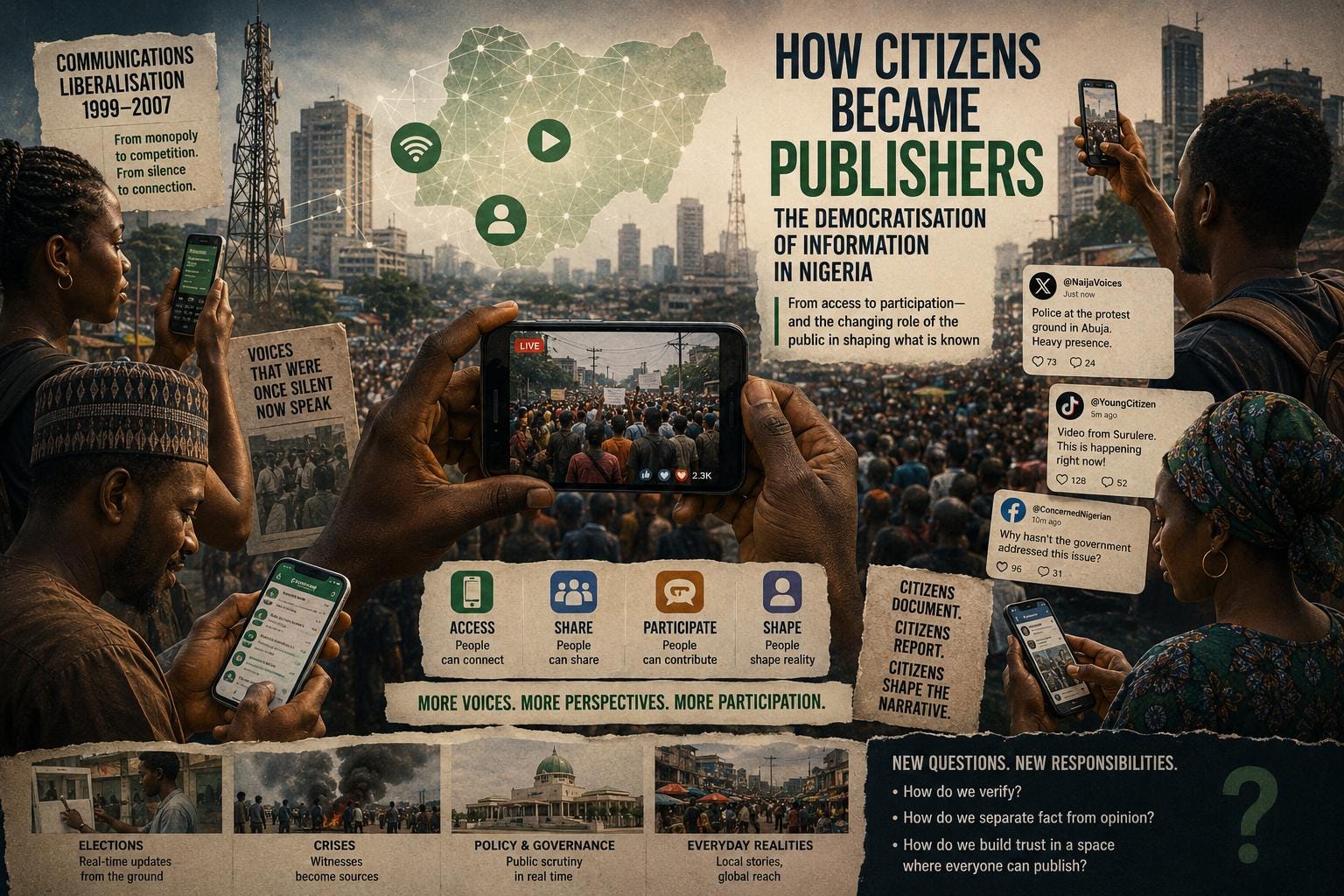
As I witnessed, you could see it during periods of tension, during major policy decisions, even during everyday governance issues. People were no longer waiting to be told what was happening. They were showing it.
Over time, the role of the citizen expanded further. It was no longer just about documenting events. People began to interpret them. To analyse. To comment. In many ways, the public sphere widened.
Conversations that would have been confined to editorial pages or studio discussions moved into open platforms. Policy decisions were debated in real time. Political actors were scrutinised not just by institutions, but by the public.
This was, in a very real sense, a democratisation of information.
More voices. More perspectives. More participation.
But as I’ve watched this evolve, it has also become clear that access alone does not resolve how information is shaped. It complicates it. Because when more people can produce and distribute information, the structure that once helped organise it becomes less defined.
The lines between reporting, commentary, and speculation begin to blur. And not always in obvious ways.
One of the most noticeable changes has been the speed at which information moves.
In the earlier system, there was time—however limited—for verification, for editing, for context. Now, information often travels as it is being formed.
A video appears. It is shared. Reactions follow. Interpretation builds. Context sometimes comes later. Sometimes it doesn’t.
This does not mean the shift has been negative. There are clear gains. Issues that might have gone unnoticed are now visible. Communities that were previously unheard now have a platform. Power is observed from more angles, not just through official channels. For me, that matters. It changes how accountability works.
Accordingly, it also introduces new questions: If everyone can publish, how do we distinguish between what is observed and what is assumed? If information travels instantly, where does verification sit? If commentary and reporting exist in the same space, how are they separated? These are not abstract concerns. They shape how events are understood in real time.

In Nigeria, where social, political, and economic issues are often closely intertwined, the stakes are higher. Information can influence perception quickly. Narratives can take shape before facts are fully established. And once they settle, they are not easily reversed.
I’ve seen situations where initial reports—shared widely—set the tone for public understanding, even when later information suggested a more complicated reality. By then, the moment had already moved on.
What this points to is a shift not just in access, but in responsibility. When information was more centralised, responsibility was easier to locate. It sat with institutions, with editors, with journalists.
Now, it is distributed. Everyone who records, shares, comments, or amplifies plays a role—whether consciously or not.
As I see it today, democratisation of information has expanded participation. It has made the public sphere more immediate, more responsive, more open. But it has also made it less structured. And in that space, the question is no longer just who has access to information. It is how that information is shaped, understood, and trusted.
Looking back, this shift feels like a natural extension of what began with communication liberalisation: First, people could connect; Then, they could share; Now, they can shape.
And once that happens, the role of the citizen changes permanently. Not just as a participant in democracy—but as a participant in how reality itself is presented. That is not a small change. It is a consciously conceived structural one. And it is one that continues to evolve.
This is part two of a five-part reflection on Nigeria’s democratic journey and the evolving role of communication across the country