
On the night of April 3, in Nyamgo Gyel, Jos South, three people were killed on their way home. Days earlier, in Angwan Rukuba, more than two dozen had died in a single attack that drew national attention and a presidential visit. Yet within 48 hours, violence returned.
This is the pattern now defining insecurity in Nigeria: not isolated incidents, but recurrence. Not shock, but sequence.
And beneath that sequence lies something deeper—a vacuum.
Not the absence of government entirely, but the absence of predictable, everyday security where people live, work, and move. A gap between formal presence and lived reality.
Insecurity in Nigeria is often described in parts: banditry in the Northwest, insurgency in the Northeast, communal clashes in the Middle Belt. Each is real. None is sufficient.
What connects them is this vacuum—felt most clearly not in capitals, but in rural roads, farms, and small communities.
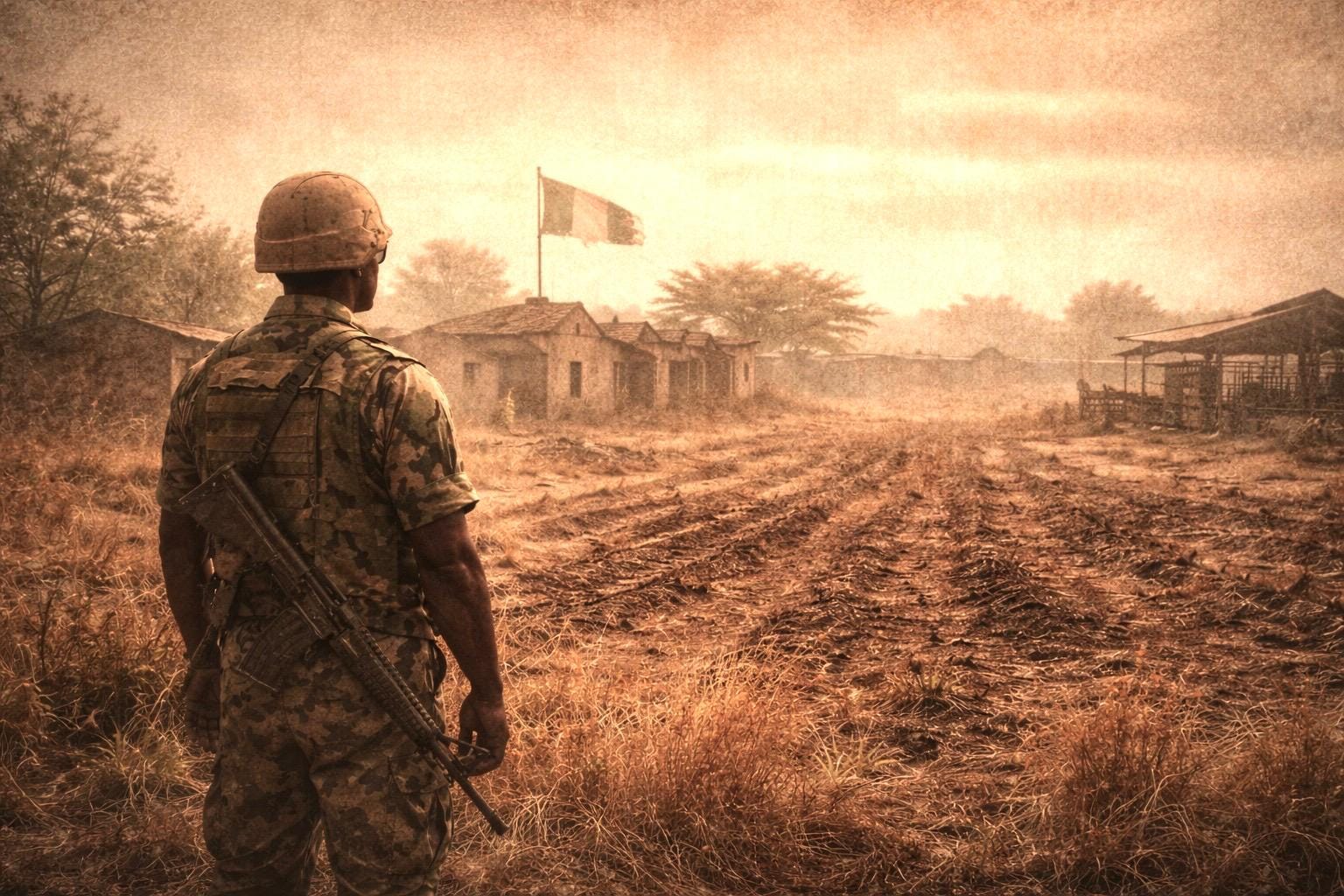
In Zamfara State, communities live with the expectation of attack. Raids are not exceptional; they are routine. In some areas, repeated assaults have left villages partially or completely deserted, with farming activity significantly reduced across high-risk zones.
In the Northeast, ISWAP and Boko Haram continue to probe the limits of state control. Territory may be reclaimed, but stability rarely holds for long, with attacks on both civilians and military positions persisting despite ongoing operations.
In Plateau State, violence is harder to classify—and therefore harder to resolve. Communal tensions, land disputes, and opportunistic attacks overlap, producing cycles that return as quickly as they fade.
Different dynamics. One underlying condition: uncertainty shaped by absence.
That uncertainty is not abstract. It is economic.
Nigeria’s agricultural system—employing roughly one-third of the workforce—depends on movement: farmers to fields, goods to markets, traders across regions. The vacuum disrupts each link.
Farmers scale back or avoid distant plots altogether. In some affected areas, cultivation has shrunk noticeably as insecurity limits access to land. Transporters factor risk into pricing—or avoid certain routes entirely—creating informal “risk premiums” that feed directly into market costs.
Traders respond in kind. Inventory shrinks. Supply becomes uneven.
The effect compounds. Production falls. Distribution weakens.
Prices rise—not only because of macroeconomic pressures, but because supply chains themselves are under strain. Food price pressures have become increasingly volatile, reflecting both broader economic shifts and recurring security disruptions.
This is how violence in rural areas shows up in urban markets: gradually, then persistently.
In the Northwest, the damage runs deeper. Armed groups do not just extract value; they undermine future production. Land is left uncultivated. Communities disperse. Recovery, when it comes, is slow and uneven.
Over time, behaviour adjusts. Safer, smaller choices begin to outweigh productive but exposed ones.
At the same time, a parallel system is expanding into the space the state does not fully occupy.
Kidnapping for ransom has become structured, predictable, and increasingly normalized. Payments are negotiated. Families mobilize funds. Communities absorb the cost.
For armed groups, it provides liquidity. For households, it functions as a hidden tax—paid in cash, assets, and long-term sacrifice.
And it scales. Each successful abduction lowers the barrier for the next.
What emerges is not just criminality, but an economy shaped—and sustained—by coercion.
The human impact of this vacuum is most visible in displacement.
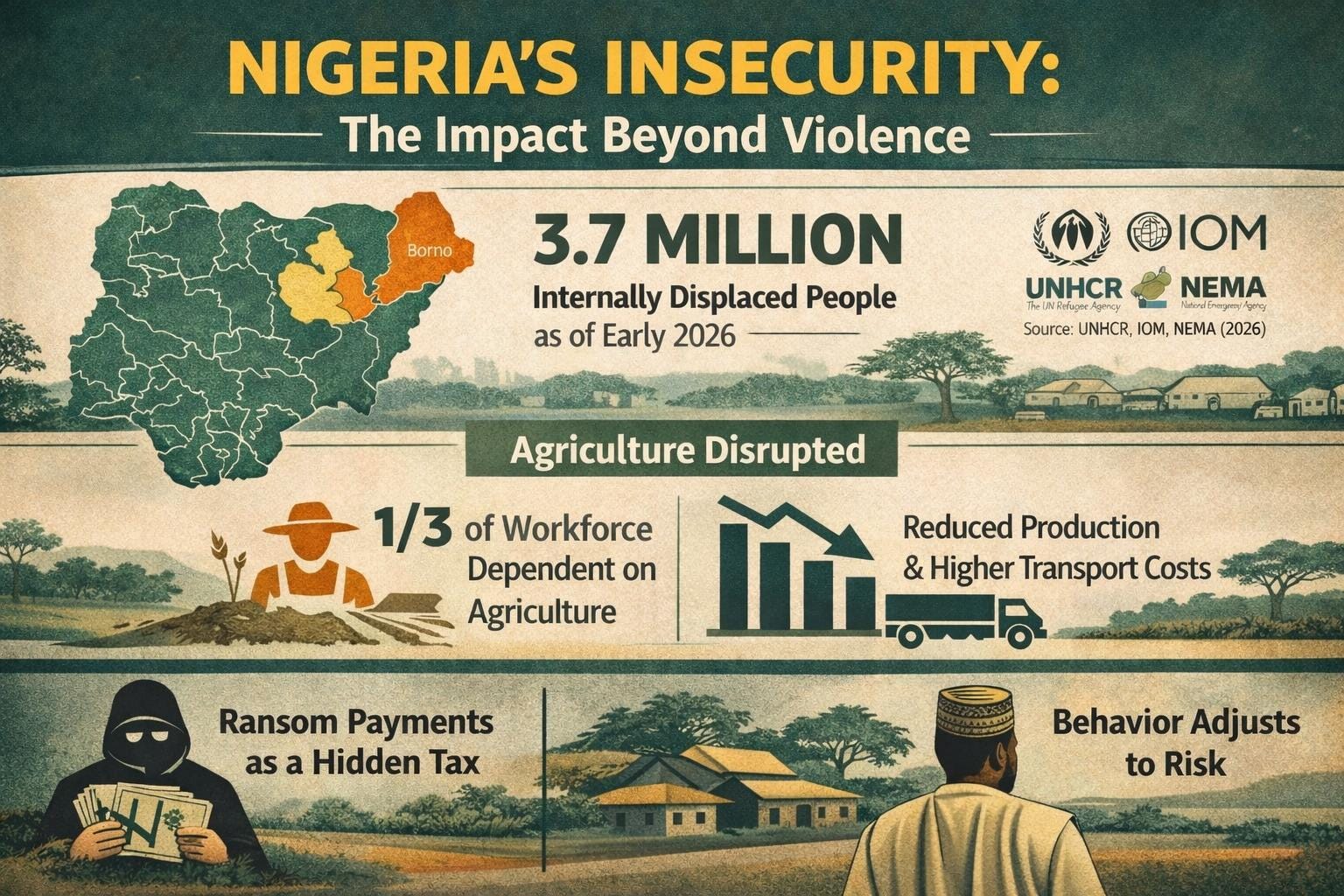
Across Nigeria, an estimated 3.7 million people are internally displaced as of early 2026, according to figures from the United Nations High Commissioner for Refugees (UNHCR), International Organization for Migration (IOM), and Nigeria’s National Emergency Management Agency (NEMA). The majority are concentrated in northern regions affected by insurgency, banditry, and communal violence.
Some move to camps. Others to towns or relatives. Few return quickly.
Livelihoods disappear. Education stalls. Social networks weaken. What begins as temporary disruption often becomes prolonged uncertainty.
For those who remain, adaptation is quieter but constant. Travel is restricted. Gatherings shrink. Decisions are filtered through risk.
These are small adjustments in isolation. Together, they amount to a reordering of daily life.
The policy response remains active, but uneven.
Nigeria’s security system is centralized, with federal control and heavy reliance on military deployments. It allows for coordination, but often at the cost of proximity.
Calls for state-level policing are growing. The argument is straightforward: local threats require local knowledge. The concern is equally clear—uneven capacity, and the risk of political misuse.
But beyond structure lies a deeper challenge: different threats require different responses. Criminal banditry, ideological insurgency, and communal violence operate on distinct logics. A uniform approach struggles to address them effectively.
Meanwhile, operational gaps persist. Intelligence in rural areas is inconsistent. Coordination between agencies can be fragmented. Accountability after repeated incidents remains limited.
The system responds. It does not always reassure.
What is changing is not just the scale of insecurity, but its status.
When attacks recur within days, as in Plateau State, they stop feeling exceptional. They become expected.
And when expectations shift, behaviour follows.
Investment slows—not just locally, but nationally, as risk perceptions widen. Agricultural disruption feeds into food price volatility. Supply uncertainty ripples into urban markets.
Over time, these patterns harden—not as temporary distortions, but as structure.